
A TWIST IN THE TALE
Group exhibition
Curated by Ana Savciuc
In collaboration with SUBSTRAT
March 14–March 16, 2025
FLUTGRABEN
Am Flutgraben 3, 12435 Berlin
Stories crave beginnings, middles, and ends. Paintings resist such structures. They speak in fragments, ruptures, absences, and disjunctions.
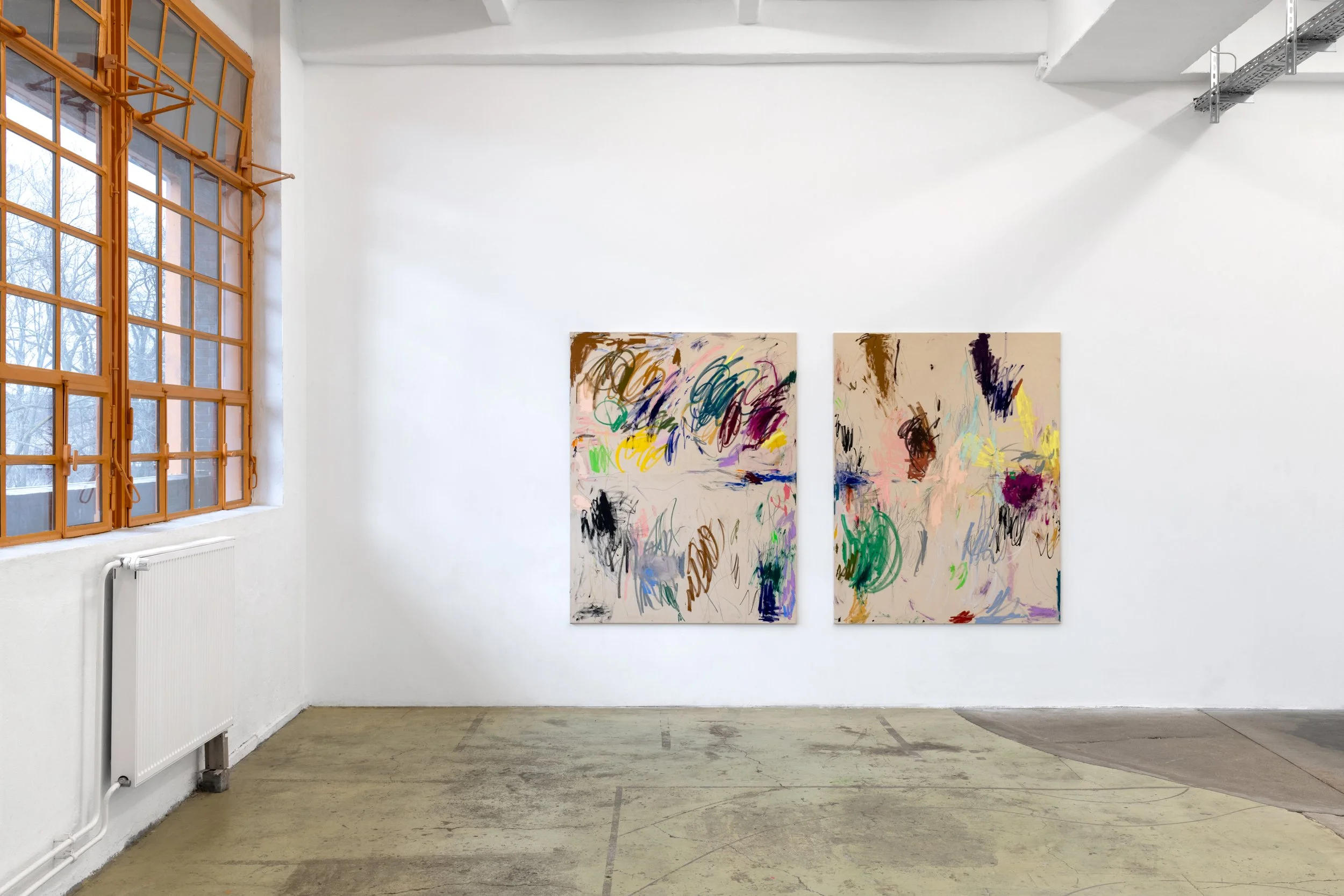
The group exhibition A Twist in the Tale brings together eight artists – Okka-Esther Hungerbühler, Kallirroi Ioannidou, Aneta Kajzer, Tim Leimbach, Tom Król, Linou Meyer, Solveig Schmid, and Marta Vovk – who approach painting not as representation, but as process, as event, as space. Here, storytelling drifts in gestures rather than sequences. A misplaced colour, a dissolving figure, a shattering form, a persistence of line — these are not mere details but bold interventions. The works do not unfold in the linear fashion that narrative typically requires. Instead, they remain suspended in a state of tension, where meaning teeters on the threshold. The paintings themselves hover between abstraction and figuration, the forms between presence and absence, the gestures between control and surrender, and the space between surface and depth.
In this delicate interplay, paint becomes both witness and testament to alteration. Through its layers and traces, it reveals the ongoing process of transformation. The forms communicate — at times resembling familiar signs, at others appearing as fragmented silhouettes, isolated shapes, or excessive lines. Rather than seeking clarity, these works embrace ambiguity. The unfilled space is not a void; it’s an invitation — a place for the viewer to project, imagine, and participate in the formation of meaning. There is an immediacy to the process, a sense of urgency — but also a quiet invitation to look again, to reconsider. These paintings are not endpoints; they are points of departure, initiating conversations that stretch beyond the frame.
In this way, the exhibition becomes a space of destabilisation, where change is the only constant. The artist’s hand is always present, yet it does not dictate. It coexists with the flickering agency of the viewer, whose gaze is neither neutral nor passive. We bring with us histories, assumptions, and fleeting moods. We see through the filters of memory and expectation — and because of this, the image itself is never still. It destabilises, resists capture, and refuses the illusion of a singular, resolved meaning. And precisely in this resistance lies the power of these works.


